

%201.png)

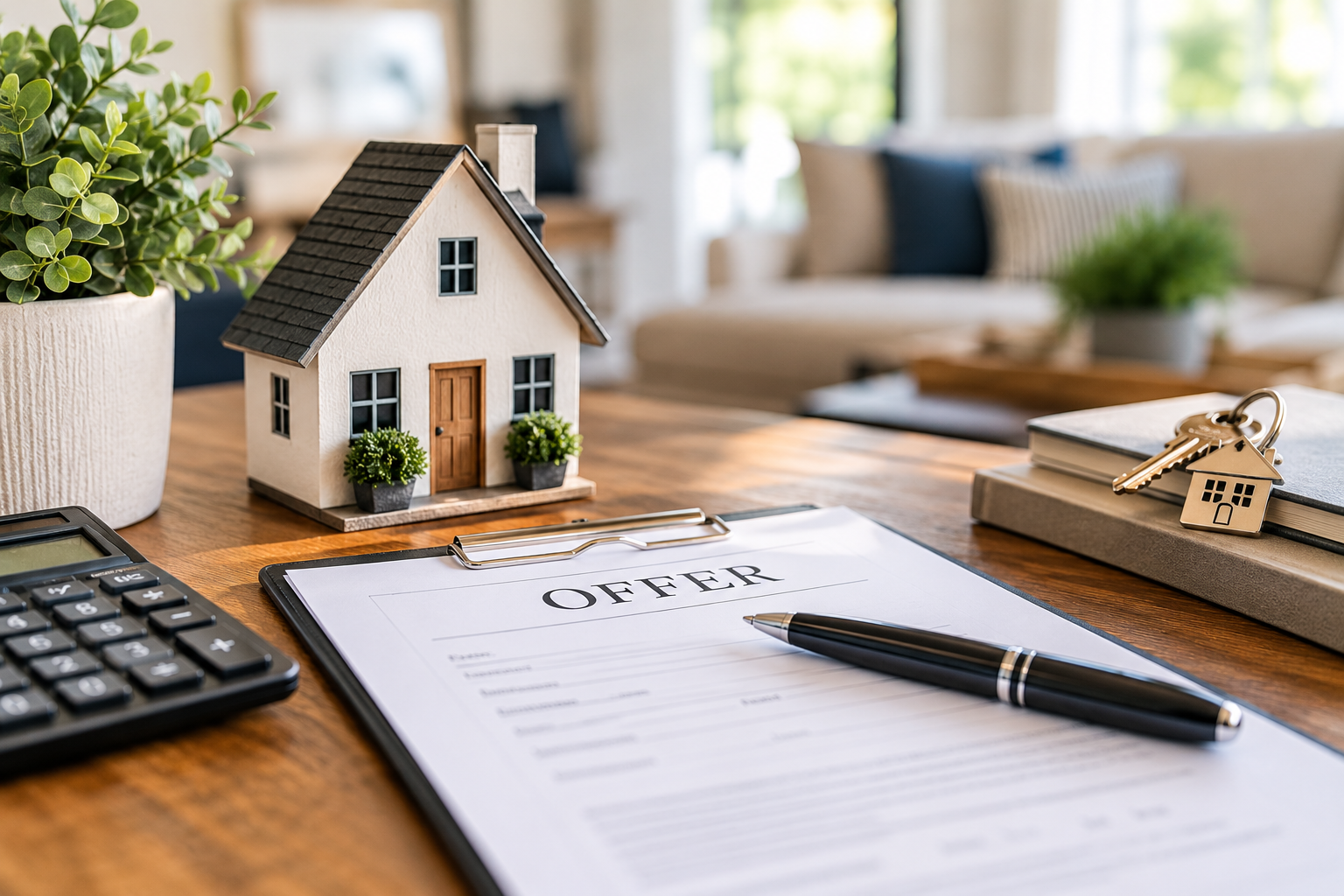
How Much Should You Offer on a House?

Krista Hartmann
Comfortable and confident – those are some of the feelings you come away with after meeting Krista...
Comfortable and confident – those are some of the feelings you come away with after meeting Krista...
How Much Should You Offer on a House?
You've found the house.
You love the location. The layout works. The numbers are within your budget.
Now comes one of the biggest questions in the entire home-buying process:
How much should you offer?
Should you offer the asking price?
Start below it so you have room to negotiate?
Offer above asking because there may be other buyers?
There isn't a standard answer—and that's actually one of the most important things I want buyers to understand.
After helping buyers and sellers throughout the St. Louis area since 2014, I've learned that the right offer has very little to do with following a rule like "always offer 5% below asking."
Instead, we need to evaluate the individual property, the local market, the seller's pricing, the amount of buyer competition, and—most importantly—what the home is worth to you.
The List Price Is a Starting Point, Not a Statement of Value
One of the first misconceptions I see with buyers is assuming that the asking price tells us exactly what the home is worth.
It doesn't.
The list price is the price the seller and listing agent chose to put on the property.
Sometimes it's right in line with market value.
Sometimes a home is intentionally priced competitively to generate significant buyer interest.
And sometimes it's simply overpriced.
That's why I don't want my buyers automatically deciding what to offer based on the list price alone.
If a home is listed at $400,000, offering $390,000 isn't automatically a "good deal."
If comparable properties suggest the home is worth $375,000, $390,000 might actually be high.
On the other hand, if the property is listed at $400,000 and comparable homes have recently sold around $425,000, an offer of $390,000 may have very little chance of succeeding.
We need context.
Comparable Sales Help Us Understand the Market
When appropriate, one of the things I'll look at before we write an offer is recent comparable sales.
What have similar homes actually sold for?
I'm looking at factors such as:
- Location
- Size
- Condition
- Bedrooms and bathrooms
- Lot
- Finished living space
- Garage
- Basement
- Updates
- Age and style of the home
- Recent market activity
No two properties are exactly alike, so this isn't simply a mathematical exercise.
A beautifully updated home shouldn't necessarily be valued exactly the same as a similar-sized home that hasn't been updated in 30 years.
Likewise, a home backing to a busy road may not compare directly with one on a quiet cul-de-sac.
This is where local market knowledge becomes important.
Days on Market Can Change the Strategy
One of the first things I want to know is how long the property has been listed.
A house that hit the market yesterday is a very different negotiating situation from one that's been available for 45 days.
If a desirable St. Louis area home was listed Friday and already has heavy showing activity Saturday morning, we probably shouldn't assume the seller will negotiate substantially below asking price.
But what if the home has been sitting for several weeks?
Maybe there have been price reductions.
Maybe the seller hasn't received an offer.
Maybe they've already moved.
Now we may have more negotiating room.
This doesn't mean every older listing is overpriced or every new listing requires a full-price offer.
It means days on market give us information.
And information helps us develop our strategy.
I Want to Know What's Happening Behind the Scenes
This is where one of the most important parts of my job happens—and buyers don't always see it.
If my buyer is seriously considering writing an offer, I call the listing agent.
I introduce myself and start asking questions.
Has there been much interest?
Do you have any offers?
Do you have offers over list price?
Is there an offer deadline?
Is the seller definitely waiting until that deadline, or would they consider accepting an offer sooner if one makes sense?
Is there anything particularly important to the seller?
Sometimes the listing agent will answer most of my questions.
Sometimes they can't or won't disclose certain information.
That's completely understandable.
But I ask.
And I've found that these conversations can be incredibly helpful when deciding how to structure an offer.
Seller Motivation Can Matter
Sometimes the seller's priorities aren't exactly what buyers assume.
Yes, sellers generally want a strong price.
But price may not be the only thing that matters.
Maybe they've already purchased another home and would prefer a quick closing.
Maybe they're building and need additional time before moving.
Maybe certainty matters more than squeezing out every last dollar.
Perhaps there's another term that would make an offer more appealing.
If the listing agent can appropriately share information about what matters to the seller, we can consider that when developing our offer.
That's why I don't believe real estate negotiation is simply about picking a number.
It's about understanding the entire situation.
What If There Are Multiple Offers?
This is where the strategy can change quickly.
As I discussed in Article 30, when I know my buyer is going to be competing, communication with the listing agent becomes especially important.
If showings have just started, I may check back a day or two later.
Do they have offers now?
Has the situation changed?
Are offers coming in over asking?
Is the seller still planning to wait for the deadline?
If speed appears to be important, I may talk with my buyer about submitting the strongest offer they're comfortable making as quickly as possible.
I've seen this help buyers win homes.
But notice something important:
I said the strongest offer they're comfortable making.
I don't want a buyer getting caught up in competition and agreeing to a price or terms they'll regret the next morning.
Our goal isn't simply to win.
Our goal is to buy the right home on terms you're comfortable accepting.
Should You Always Offer Less Than Asking?
No.
This is probably one of the biggest myths in home buying.
I've heard buyers say:
"But aren't you supposed to offer less? That's how negotiating works."
Not necessarily.
If the property has been sitting on the market, is priced above comparable sales, or needs significant work, offering below asking may make perfect sense.
But if a home is well priced and has multiple interested buyers, offering substantially below asking simply because you feel like you're "supposed to negotiate" could cost you the house.
Negotiation isn't about automatically asking for a discount.
It's about understanding your leverage.
Sometimes the buyer has it.
Sometimes the seller has it.
Sometimes neither side has much of it.
Condition Should Affect Your Thinking
The condition of the property is another factor.
Suppose we're looking at two homes in the same neighborhood.
Both are listed at $425,000.
One has a newer roof, updated HVAC, renovated kitchen, newer flooring, and excellent overall maintenance.
The other needs substantial cosmetic updating and may have several major systems approaching the end of their expected useful lives.
Those homes shouldn't necessarily be evaluated the same way just because they have the same asking price.
We need to consider what you're actually purchasing.
That doesn't mean subtracting the full retail cost of every improvement you'd like to make.
But condition absolutely belongs in the conversation.
Don't Base Your Offer on What the Seller Paid
Buyers sometimes look up the seller's previous purchase price and say:
"They only paid $250,000 for this house. Why should I pay $400,000?"
Because what the seller paid isn't how current market value is determined.
Maybe they bought the home 15 years ago.
Maybe they've made significant improvements.
Maybe values in the area have increased.
The relevant question isn't:
"How much profit is the seller making?"
It's:
"What is this property worth in today's market?"
That's what we need to evaluate.
What About Offering an Odd Number?
Sometimes buyers ask whether an offer should be a nice round number.
It doesn't have to be.
There can be situations where an offer of $407,500 makes more sense to a buyer than $405,000 or $410,000.
Maybe that's the exact amount they're comfortable paying.
Maybe we're trying to position the offer slightly above what we believe other buyers might choose.
There isn't anything magical about numbers ending in zero or five.
Again, the offer should reflect our strategy.
Decide How Much the Home Is Worth to You
Comparable sales and market data help us estimate value.
But there's another question only you can answer:
How much is this particular house worth to you?
Imagine a home is listed at $400,000 and we know there's competition.
You tell me you're considering $410,000.
I may ask:
"If someone else buys this house for $412,000, how are you going to feel?"
If your response is:
"That's fine. I wouldn't have paid $412,000."
Great.
We've probably found your limit.
But if you immediately say:
"I'd be sick! I'd absolutely pay another $2,000 for this house."
Then maybe we need to reconsider.
I'm not trying to talk you into spending more money.
I'm trying to help you determine your own comfort level before the seller makes a decision.
That way, if we don't get the house, you can walk away knowing you made the strongest offer that made sense for you.
Remember the Appraisal
If you're financing the purchase and considering an offer substantially above the asking price—or above what recent comparable sales appear to support—we also need to talk about appraisal risk.
As we discussed in Article 32, the purchase price and appraised value aren't necessarily going to be identical.
If the appraisal comes in below the contract price, what happens next depends on the financing and the terms of your contract.
That's why I want buyers thinking about appraisal considerations before writing an aggressive offer—not after the appraisal arrives.
A great offer strategy looks several steps ahead.
Price Isn't the Only Part of Your Offer
Another important point:
You aren't just offering a price.
You're offering a contract.
Closing date.
Financing.
Earnest money.
Inspection terms.
Appraisal terms.
Seller concessions.
Home sale contingencies.
And other terms may all influence how a seller views your offer.
Sometimes improving a term that's important to the seller can strengthen your offer without simply increasing the price.
This is one reason I communicate with the listing agent whenever possible.
If we can understand what matters to the seller, we can potentially structure an offer that works better for both sides.
Don't Let Emotion Write the Offer
Buying a home is emotional.
There's no way around that.
You're picturing your furniture in the family room.
You're imagining Thanksgiving in the kitchen.
Maybe you've already decided where the Christmas tree will go.
That's part of what makes buying a home exciting.
But when it's time to write the offer, I want us to combine that emotion with information.
What do the comparable sales tell us?
What's happening with the listing?
How much competition exists?
What are the potential appraisal considerations?
What does the payment look like?
What terms are you comfortable with?
Then we make the decision.
There's No Magic Percentage
If you search online, you'll find plenty of advice saying buyers should offer a certain percentage below asking price.
I don't believe that's particularly useful.
Real estate is too local—and individual properties are too different—for a universal formula.
The right offer on a home in Fenton could be completely different from the right strategy for a condo in St. Louis City, a home in Chesterfield, or a property in St. Charles County.
Even two homes on the same street can require different strategies depending on condition, pricing, competition, and seller circumstances.
That's why I believe good real estate representation isn't about applying a formula.
It's about evaluating the situation in front of us.
Final Thoughts
So, how much should you offer on a house?
Enough to give yourself a realistic opportunity to purchase the property—but not so much that you're uncomfortable if the seller says yes.
We'll look at the comparable sales.
We'll consider the home's condition.
We'll evaluate days on market.
I'll communicate with the listing agent and gather as much appropriate information as possible.
We'll talk about competition, appraisal considerations, financing, and terms.
And then we'll develop an offer strategy based on this house, this market, and your goals.
Sometimes that means offering below asking.
Sometimes it means offering asking price.
And sometimes, when competition is strong and the home is worth it to you, it may mean offering above asking.
The important thing isn't following a rule.
It's understanding why you're offering what you're offering.
That's how you can make a confident decision—whether your offer is accepted or we move on to the next home.
Frequently Asked Questions
How far below asking price should I offer?
There's no standard percentage. The appropriate offer depends on comparable sales, the home's condition, days on market, competition, seller circumstances, and current market conditions.
Is it bad to offer full asking price?
Not at all. If the home is appropriately priced and there's buyer interest, a full-price offer may make sense. In other situations, there may be room to negotiate.
Should I offer over asking price if there are multiple offers?
Possibly, but it shouldn't be automatic. We should consider comparable sales, the amount of competition, potential appraisal risk, your budget, and how much the home is worth to you before deciding.
Can my agent find out what other buyers are offering?
Sometimes a listing agent may appropriately share certain information about the competitive situation, and sometimes they won't. I ask questions and gather whatever information is available, but sellers and their agents aren't necessarily required or able to disclose the details of competing offers.
What if I make an offer and the seller counters?
A counteroffer gives us another decision to make. We'll evaluate the seller's proposed changes, the market, your priorities, and your comfort level before deciding whether to accept, reject, or continue negotiating.
Selling Your Home?
Get your home's value - our custom reports include accurate and up to date information.