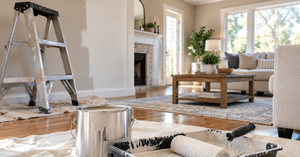
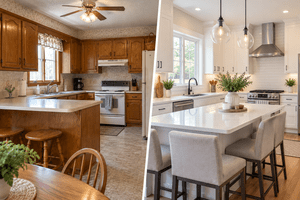
You find two homes in an area you love.
One has the updated kitchen, beautiful flooring, fresh paint, and bathrooms that look like they belong on Pinterest.
You could move in tomorrow and barely change a thing.
The other?
The kitchen is straight out of another decade. The carpet needs to go. The bathrooms are dated. And you're already mentally removing wallpaper during the showing.
But it's less expensive.
So which one is the better buy?
After helping buyers throughout the St. Louis area since 2014, I've learned that there's no universal answer. I've worked with buyers who love projects and others who would be miserable living through a renovation.
The better question is:
Which type of home is right for your budget, lifestyle, abilities, and goals?
Because buying a fixer-upper simply because it's cheaper can be a mistake. And automatically rejecting every dated home can cause you to miss some excellent opportunities.
First, What Do We Mean by a "Fixer-Upper"?
There's a big difference between a house that needs cosmetic updates and one that needs substantial renovation.
A home with dated cabinets, old carpet, wallpaper, and brass light fixtures might simply need modernization.
That's very different from a property that needs:
A new roof
Major electrical work
Plumbing repairs
Foundation work
HVAC replacement
Extensive water remediation
Significant structural repairs
When buyers tell me they're open to a fixer-upper, one of my first questions is:
"How much fixing are you actually willing to do?"
Because watching an HGTV renovation and living through one are two very different experiences.
Cosmetic Updates Can Create Opportunity
Some of my favorite opportunities for buyers are homes that are fundamentally solid but cosmetically dated.
Why?
Because many buyers have difficulty looking past finishes.
They see oak cabinets and immediately move on. They see old carpet and decide the house isn't for them. They see wallpaper and can't imagine anything else.
But paint can change. Flooring can change. Cabinet hardware can change. Light fixtures can change.
Sometimes the things turning other buyers away are exactly what create an opportunity for you.
This is especially worth considering if the home has the things that are much harder to change:
A location you love. A good lot. The right floor plan. The amount of space you need. A
neighborhood that fits your lifestyle.
Those characteristics may ultimately matter much more than the color of the kitchen cabinets.
Move-In Ready Has Real Value
On the other hand, there's nothing wrong with wanting a move-in-ready home.
Not everyone wants a project.
Maybe you work long hours. Maybe you have young children. Maybe you've already renovated three houses and promised yourself you're never doing it again.
Maybe you simply don't enjoy home improvement.
That's okay.
A move-in-ready property may cost more because someone else has already invested the time, money, and inconvenience required to complete those improvements.
You're paying for the house—but you're also paying for convenience.
And convenience has value.
Don't Assume You'll Save Money by Buying a Fixer-Upper
This is where buyers need to be careful.
Imagine the updated home costs $425,000.
The dated home costs $375,000.
At first glance, the fixer looks like a $50,000 savings.
But what if you want to replace the kitchen, update two bathrooms, install flooring, paint the entire interior, replace several fixtures, and make exterior improvements?
Suddenly that $50,000 difference may disappear quickly.
Renovations can cost more than buyers expect, particularly once work begins and unexpected issues are discovered.
Before deciding that a fixer-upper is the better financial choice, try to develop a realistic understanding of what you actually plan to change and what those projects may cost.
Know the Difference Between "Want" and "Need"
This is extremely important when evaluating a dated property.
A 20-year-old kitchen isn't necessarily a bad kitchen.
It may simply not be your style.
If the cabinets are functional, appliances work, and everything is in acceptable condition, you may be able to live with the kitchen for several years before remodeling.
That gives you time.
You don't have to renovate everything the day you get the keys.
Sometimes buyers turn a manageable home into an overwhelming project because they convince themselves everything has to be changed immediately.
It doesn't.
You can prioritize.
Major Systems Are Different
Cosmetic updates are one thing.
Major systems deserve a different conversation.
If the roof, HVAC, electrical system, plumbing, foundation, or other significant components need attention, I want my buyers to understand that before making a decision.
This is where the home inspection becomes especially valuable.
As I've discussed before, I'm not a home inspector or contractor.
But my experience helps me know when we should be asking additional questions or bringing in the appropriate professional.
If we're considering a property that needs significant work, getting good information is critical.
The cute kitchen you plan to install isn't nearly as exciting if you discover your renovation budget needs to go toward something much less glamorous first.
Financing Can Matter With a Fixer-Upper
Another thing buyers sometimes overlook is that the condition of the property may affect financing.
A home requiring significant repairs isn't necessarily financed the same way as a typical move-in-ready property.
Depending on the property's condition and the buyer's loan program, certain issues could potentially affect financing or insurance.
If you're considering a property that needs substantial work, talk with your lender early.
There are renovation loan products and other financing options that may be available in some circumstances, but they're not appropriate for every buyer or every property.
Don't wait until after you've fallen in love with a fixer-upper to find out whether your financing works with it.
Location Can Make a Fixer-Upper Worth Considering
Here's a scenario I see fairly often:
A buyer wants to live in a particular area but the updated homes are above their budget.
Now we have choices.
They can increase the budget if they're financially comfortable doing so, change locations, wait, or consider a home that needs updating.
Sometimes buying the dated house can be a way to get into the location you really want.
Over time, you can make improvements as your budget allows.
For some buyers, that's a great strategy.
For others, it would be frustrating.
Again, this comes down to knowing yourself.
Be Realistic About Your DIY Skills
This one makes me smile because many of us have watched a 30-second video and thought:
"I could do that."
Maybe you can!
But be realistic.
Painting a bedroom is one thing. Installing an entire kitchen is another.
If your renovation budget assumes you're going to personally do most of the work, make sure you have the time, skills, equipment, and desire to actually do it.
Also think about how long you're willing to live in an unfinished space.
A project that takes a professional contractor two weeks could potentially take you six months of weekends.
There's nothing wrong with DIY.
Just make sure your plan is based on reality.
Renovations Take Time
Money isn't the only cost of remodeling.
There's also inconvenience.
Dust. Noise. Contractors coming and going. Rooms you can't use. Materials that arrive late. Projects that take longer than expected.
If you're buying a home and immediately planning a major renovation, think about how that will affect your daily life.
Could you renovate before moving in?
Would you need temporary housing?
Can you comfortably live in the property while work is being completed?
If you're buying and selling simultaneously, this becomes even more important because your timeline may already be complicated.
Don't Over-Improve Without Thinking About Resale
If you're planning renovations, I also want you thinking about the future.
You should absolutely make the house your own. You're the one living there.
But if you spend far more on improvements than similar homes in the area typically support, you may not recover that entire investment when you eventually sell.
This is where I can help provide a real estate perspective.
Before undertaking a major improvement, it can be useful to understand what comparable updated homes are selling for.
Maybe the renovation makes perfect sense.
Maybe you decide to scale it back.
Or maybe you love the improvement enough that you don't care whether you recover every dollar.
That's okay too—as long as it's an informed decision.
Updated Homes May Have More Competition
There's another side to this decision.
Move-in-ready homes often appeal to a larger group of buyers.
If a home has a beautifully updated kitchen, modern bathrooms, attractive flooring, and great presentation, you're probably not the only person who noticed.
That can mean stronger competition.
A dated home may receive less attention simply because buyers can't see past the finishes.
This doesn't mean every fixer-upper is a bargain or every updated home will have multiple offers.
But presentation absolutely affects buyer behavior.
Sometimes being willing to take on a little cosmetic work can open up opportunities that other buyers overlook.
Look Past the Photos
This is another reason I encourage buyers not to eliminate every property based solely on online photos.
Professional photography is powerful.
It can make an updated home look incredible. It can also make a dated home easy to dismiss.
If the location, price, size, and major characteristics fit what you're looking for, sometimes it's worth seeing the property in person.
I've been in homes that looked disappointing online and were much better once we walked through them.
The opposite happens too.
Photos are useful.
They're not the entire house.
Think About Your Cash After Closing
If you're buying a fixer-upper, don't forget that renovations often require money relatively quickly after closing.
Suppose you're using most of your available cash for the down payment and closing costs.
Where will the renovation money come from?
That's a question we should think about before purchasing.
I don't want buyers assuming they'll immediately renovate everything and then discovering they don't have the financial flexibility to do it.
Maybe the solution is buying the home and improving it gradually.
Maybe it's choosing a different financing structure after discussing options with your lender.
Or maybe a move-in-ready property actually makes more sense financially.
A Fixer-Upper Isn't Automatically a Better Investment
There's a romantic idea that buying a fixer-upper automatically creates equity.
Sometimes it can.
But not every renovation produces a dollar-for-dollar return.
You still have to buy the property at a price that makes sense.
You need realistic renovation costs.
You need to consider the value of the home after improvements.
And you need to account for surprises.
Buying a fixer-upper can be an excellent strategy.
But the opportunity comes from buying wisely and improving thoughtfully—not simply from purchasing something that's dated.
How I Help Buyers Compare the Two
When one of my buyers is deciding between a move-in-ready home and a property needing work, I like to look at the whole picture.
We'll talk about purchase price, location, condition, comparable sales, likely improvements, major systems, potential resale, competition, your financing, and most importantly, your tolerance for projects.
I may see opportunity in a dated property.
But if you tell me the thought of spending Saturdays choosing flooring and meeting contractors makes you miserable, that opportunity probably isn't right for you.
Real estate strategy has to fit the person.
Final Thoughts
So, should you buy a fixer-upper or a move-in-ready home?
Neither is automatically better.
A fixer-upper may give you an opportunity to buy in a location you couldn't otherwise afford, customize a home to your taste, or potentially create value over time.
But renovations cost money, take time, and almost always involve some inconvenience.
A move-in-ready home may cost more upfront and attract more competition, but someone else has already done much of the work.
The right decision comes down to your budget, lifestyle, financing, timeline, and appetite for projects.
When I'm helping St. Louis area buyers compare homes, I don't just want to know which property looks better today.
I want us thinking about what each one will require after you own it.
Sometimes the dated house is the hidden opportunity.
Sometimes paying more for the finished home is worth every penny.
And sometimes the smartest decision becomes obvious once we stop looking only at the asking price and start looking at the complete picture.
Frequently Asked Questions
Is a fixer-upper always cheaper than a move-in-ready home?
The purchase price may be lower, but that doesn't necessarily mean the total cost will be. Buyers should consider renovation expenses, major systems, financing, and unexpected repairs when comparing properties.
Is a dated kitchen a reason not to buy a house?
Not necessarily. Cosmetic items can often be changed over time. If the location, floor plan, condition, and other major characteristics work for you, a dated kitchen may be a compromise you're comfortable making.
Can I get a mortgage on a house that needs repairs?
It depends on the condition of the property and your loan program. Certain property conditions can affect financing, so discuss the home with your lender before assuming a particular loan will work.
Should I renovate a fixer-upper immediately after closing?
You don't have to. Unless an issue requires prompt attention, many buyers choose to live in the home for a while and prioritize improvements over time.
How can I tell if a fixer-upper is a good investment?
Look beyond the discounted purchase price. Consider comparable sales, renovation costs, the property's location and condition, financing, and what similar updated homes are worth. An experienced local REALTOR® can help you evaluate the real estate side of that decision.